

Shares 2
Yamaha DiASil vs Suzuki SCEM – Feature Analysis on Two Japanese Motorcycle Engine Technologies
Last updated on 17-Jun-2026 , By Noor
Yamaha DiASil and Suzuki SCEM are two very well-known Japanese engine technologies, under which many motorcycles are built we can see in the markets. And, there are so many discussions and debates that have taken place among the motorcycle freaks about these two engine technologies. So, everyone is busy of proving the best engine technology in favor of their favorite motorcycle brand. Therefore, today here we will try to analyze the features of these two Japanese engine technologies, Yamaha DiASil vs Suzuki SCEM.
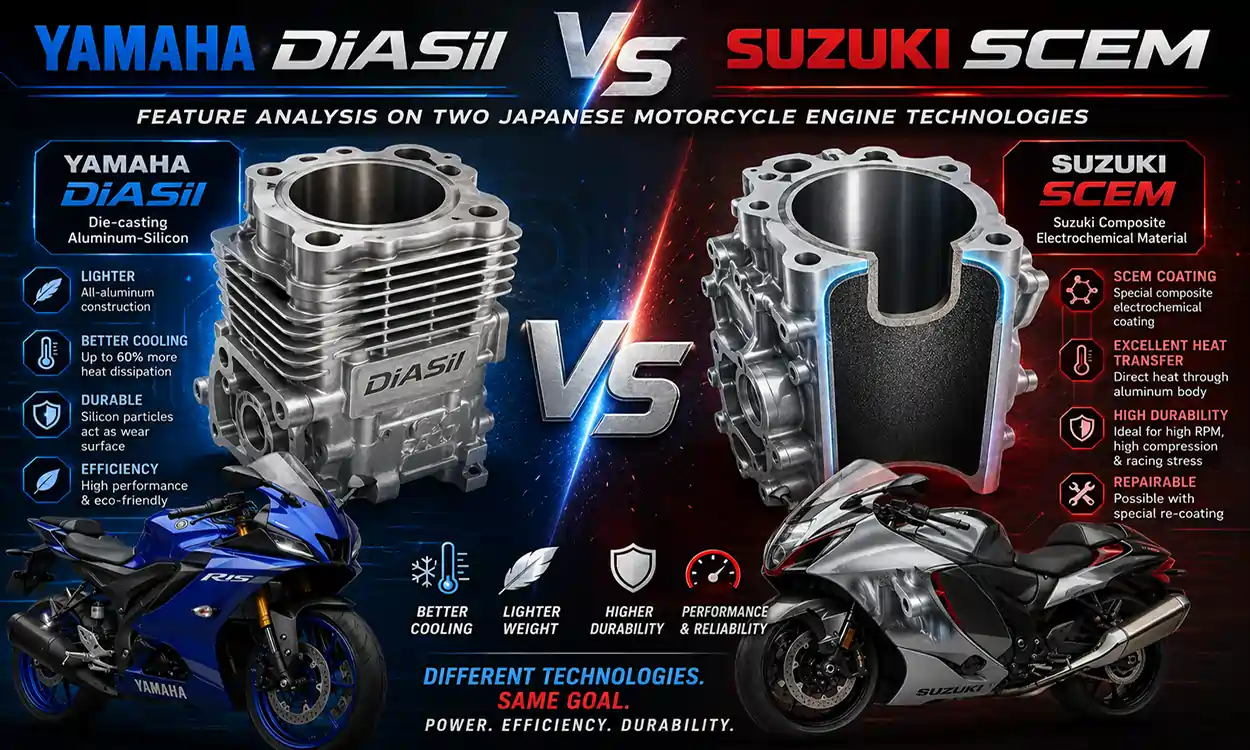

Yamaha DiASil vs Suzuki SCEM – Feature Analysis on Two Japanese Motorcycle Engine Technologies
In the global motorcycle industry, the power, reliability, and durability of any motorcycle engine largely depend on the engine cylinder technology. Yamaha and Suzuki, two Japanese motorcycle manufacturers, have been working on various technologies for many years to reduce cylinder friction, improve cooling efficiency, and reduce the weight of their motorcycle engines.
Accordingly, several years ago, Global Yamaha successfully launched DiASil (Die-casting Aluminum-Silicon) technology, and Suzuki launched SCEM (Suzuki Composite Electrochemical Material) technology. Though the path is completely different, both the brands succeed in their respective fields with their own technologies, because the goal of the two technologies is almost the same, to create a lighter, cooling efficient, and durable engine. So here we will try to dive into the details of both technologies.
Yamaha DiASil – Engine Cylinder Material Technology
Global Yamaha, in the early 2000s, started manufacturing the world's first mass-produced all-aluminum die-cast engine, called the DiASil (Die-casting Aluminum-Silicon) Engine. In this technology, the engine cylinder block is made entirely of a special 20% silicon-containing single aluminum alloy block. As a result, it does not require a separate iron sleeve or reinforced metal plating inside the cylinder wall.
Key Features of Yamaha DiASil Engine
According to Global Yamaha, the DiASil cylinders used in the Yamaha motorcycle engines are rich in some special features. They are significantly lighter than conventional steel-sleeve cylinders and their cooling efficiency is much higher. And these cylinder blocks are basically:
>> 20% silicon material-rich aluminum alloy single block.
>> The entire cylinder is made of an aluminum alloy block.
>> It does not have any reinforced iron sleeve inside.
>> The silicon particles of the cylinder block act as the main wear surface.
>> This naturally ensures higher heat dissipation.
>> Naturally, these cylinder blocks weigh much less.
Suzuki SCEM – Cylinder Side Wall Reinforced Coating Technology
Unlike Yamaha's DiASil Cylinder, Suzuki SCEM engine technology is very different, and Suzuki has chosen a different path for their motorcycle engines. In Suzuki SCEM (Suzuki Composite Electrochemical Material) technology, a special electrochemical composite coating is applied to the inner bore of the cast aluminum cylinder. This coating is extremely hard, friction-resistant, and heat transfer-friendly.
In other words, where Yamaha has made their engine cylinder material special, Suzuki has given special treatment to the inner wall of their engine cylinder. As a result, along with the special benefits, the production costs of the cylinder blocks also have been reduced significantly. However, Suzuki also has been using this technology successfully for many years in their high-performance sportbikes like the GSX-R series and Hayabusa.
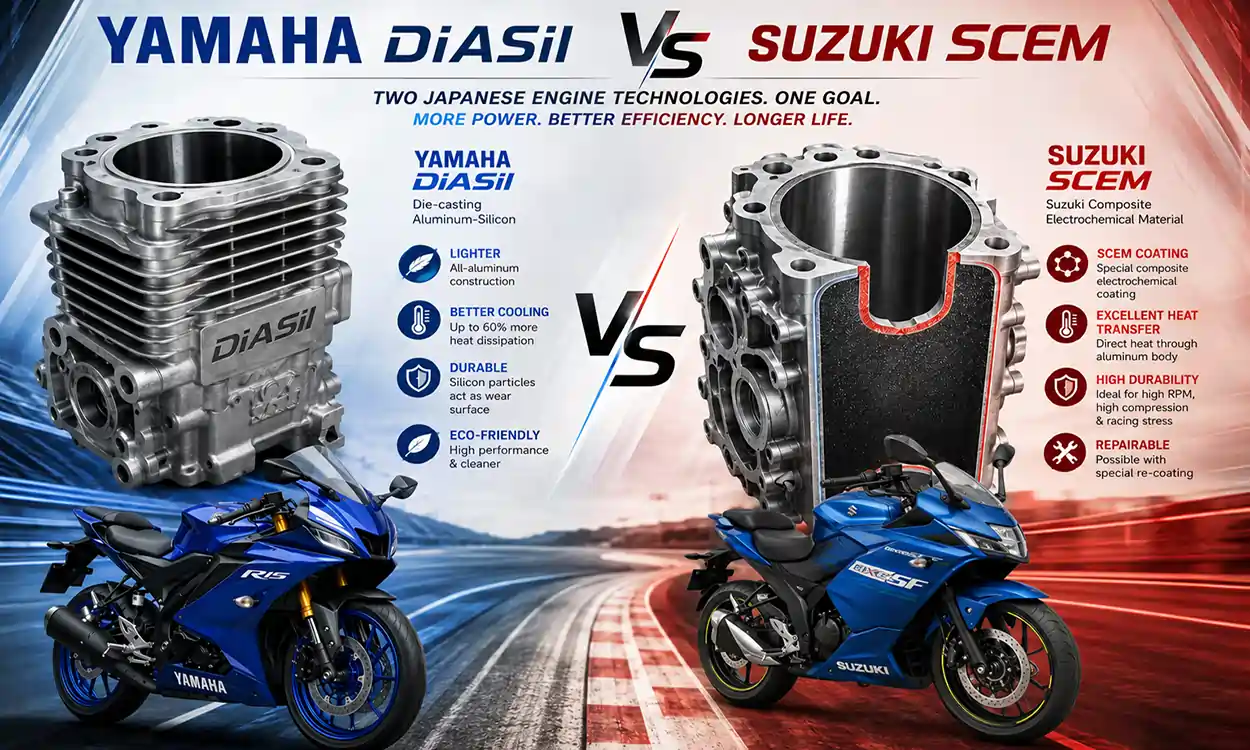
Yamaha DiASil vs Suzuki SCEM – Which is the best?
So, from the ordinary motorcyclist’s perspective, naturally the question arises, which of these two technologies is actually the best, Yamaha DiASil or Suzuki SCEM? And to find the answer, we should look at the common features of these two engine technologies, which already have mentioned in their general description above. However, the table below will be more helpful to get the differences between them at a glance.
|
Features |
Yamaha DiASil |
Suzuki SCEM |
|
Technology Type |
Construction Material Technology |
Surface Coating Technology |
|
Cylinder Construction |
All-aluminum + Silicon Alloy |
Aluminum Cylinder + SCEM Coating |
|
Iron Sleeve |
No |
No |
|
Cooling Efficiency |
Very Good |
Very Good |
|
Weight |
Very Light |
Very Light |
|
Wear Resistance Material |
Silicon Particle |
Composite Coating |
|
Manufacturing Process |
Single Block Die-Casting |
Electro Chemical Coating Process |
|
Repairability |
Relatively Complex or Not Possible |
Possible with Special Re-Coating |
Cooling Performance – Who is Ahead?
In addition, when discussing the special features and benefits of Yamaha DiASil vs Suzuki SCEM, some other things need to be considered. For example, in terms of cooling efficiency, both technologies are much ahead of the conventional iron-sleeve cylinders.
According to Yamaha's own research, DiASil cylinders can provide about 60% more cooling efficiency than conventional steel-sleeve cylinders. On the other hand, Suzuki's SCEM-coated cylinders also can transfer heat directly through the cast aluminum body. As a result, a little more or less, the cooling efficiency of both is much better.
Durability – Who is Ahead?
In the discussion of Yamaha DiASil vs Suzuki SCEM, who is ahead in durability is also a matter of debate. Yamaha's DiASil's special silicon particles create a solid wear surface on the cylinder inner wall. As a result, its wear resistance is very good; and as it is the same material block, even upper size pistons can be used easily after a while. Therefore, Yamaha has been successfully using DiASil blocks in many of their mid-to-low capacity commuters, scooters, and sportbikes. However, Yamaha is maintaining a different engine technology for higher capacity bikes.
On the other hand, the SCEM coating on Suzuki's engine cylinder blocks is very strong and durable, which is basically developed specifically for high-RPM operation applications. And Suzuki has been using this same technology for a long time in their superbike level engines, besides to their common range of motorcycles. Since SCEM can especially tackle high RPM, high compression, and high temperature conditions very well, so there no question remains on their durability.
Manufacturing Philosophy – The Real Difference
At the end of the discussion of Yamaha DiASil vs Suzuki SCEM, we can say that the real difference and specialty of the engine technology of these two brands is actually in their manufacturing philosophies. Yamaha wants their engine cylinder blocks to be light-weight, efficient, easy-to-manufacture, environment-friendly, and high-volume production-friendly. That is why they have emphasized on construction material engineering and are successfully using DiASil technology.
On the other hand, Suzuki wants a type of cylinder block in their engines that will have low production costs, but will ensure performance and efficiency, withstand racing stress, remain stable under extreme RPM conditions, and above all provide the lowest friction; so they have given priority to cylinder wall coating treatment technology. As a result, they are using this same technology in almost all of their motorcycles.
Therefore, in reality, Yamaha DiASil vs Suzuki SCEM both technologies are successful in their respective fields. And it is really difficult to pinpoint the differences and special advantages of these technologies at the consumer level. And the main thing is that users generally won't be able to really feel the difference between these two technologies over the lifetime of their motorcycles. So, choose your favorite brand worry-free, and do happy and safe biking.
T
Published by Noor

About Noor
Greetings! I am Noor Bappy, an accomplished SEO Expert with a wealth of experience spanning six fruitful years. Throughout my journey, I've had the privilege of propelling over 46 sites to the pinnacle of Google's rankings, a testament to my expertise in the realm of digital optimization. My approach to SEO is rooted in a deep understanding of algorithms and an acute awareness of industry trends. This allows me to craft strategies that not only elevate visibility but also foster sustained growth for businesses across various sectors. In the realm where keywords hold their sway, I've tread for six years, night and day. Noor Bappy, they call me, SEO's trusted hand, A maestro of rankings, across the digital land.


Best Bikes

Price: 169800

Price: 255000

Price: 212000


