

Shares 2
CFMoto Adaptive Aero – Is This Chinese Technology Changing the Future of Superbikes?
Last updated on 23-Jun-2026 , By Saleh
One of the biggest changes or additions to motorcycle technology over the past decade in the global superbike industry is the use of aerodynamic winglets. Starting from MotoGP, this technology is now also very popularly seen on road-legal superbikes from brands like Ducati, Aprilia, BMW, and Honda. However, Chinese motorcycle manufacturer CFMoto is now working on a CFMoto Adaptive Aero technology that could obsolete the concept of fixed winglets on superbikes. Let’s learn more in detail about it.

What Exactly is CFMoto Adaptive Aero?
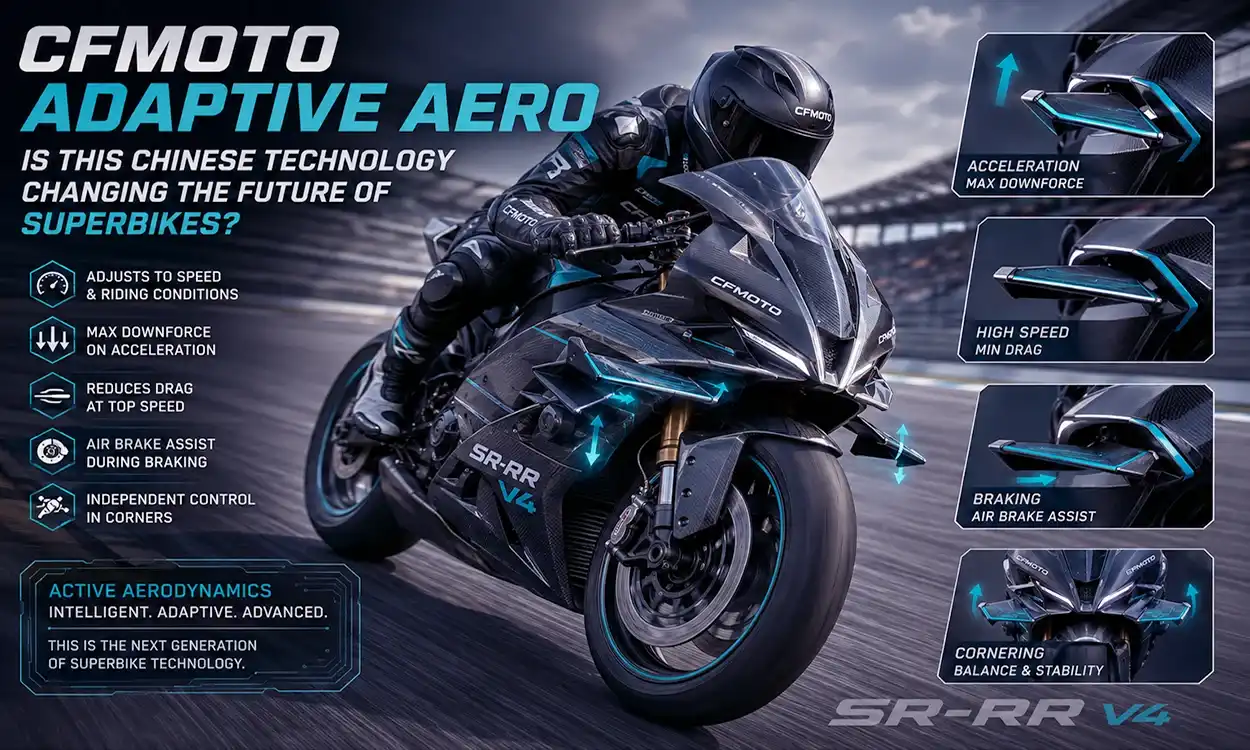
CFMoto recently revealed their new SR-RR V4 superbike prototype and a technology patent at the EICMA motorcycle exhibition held in Milan, Italy, last November that gave a glimpse of their new Adaptive Aero technology. CFMoto Adaptive Aero is a system where the bike's winglets do not remain fixed always but change their position according to the varied riding conditions.
CFMoto's Adaptive Aero or Active Aerodynamics technology is really interesting because it is a new concept in the current superbike industry. Because the winglets of current superbikes are usually fixed. Their function is to create a kind of additional pressure or downforce on the front wheel at high speeds, so that the bike remains stable on the surface and the tendency to wheelie during quick acceleration is reduced.
On the other hand, in the CFMoto Adaptive Aero system, the bike's winglets will be controlled electronically according to the speed. And the angle of the winglet will also change based on the bike's ECU, IMU sensor, speed, throttle input, and braking data. That is, the same winglet can do different things in different situations. As a result, more precise utility and performance could be gained in extreme riding conditions.
Benefits In Aggressive Acceleration
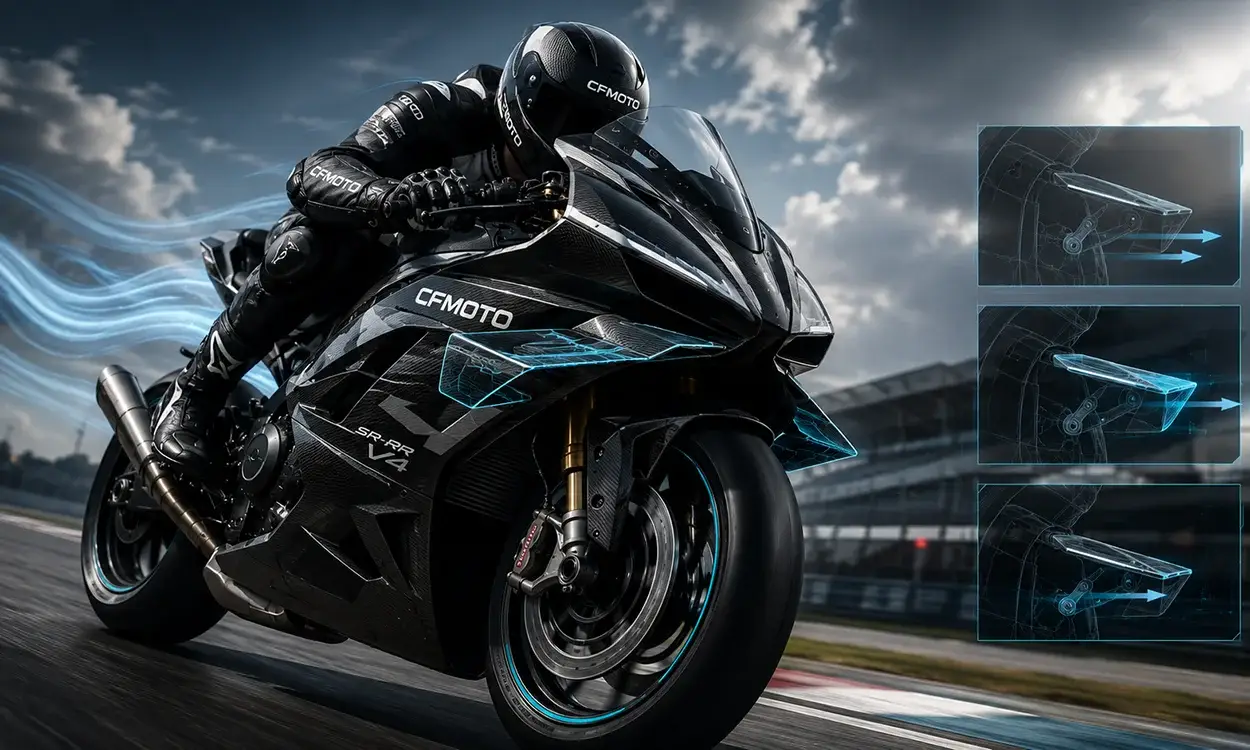
During quick and aggressive acceleration on superbikes or track racing bikes, the front wheel often tends to lift off the surface. In such conditions, CFMoto Adaptive Aero will change the angle of the bike's winglet in such a way that additional downforce may create at the front. As a result, unwanted wheelies will be reduced, grip on the front wheel will increase, power delivery will be easier at high speeds, and reliance on electronic wheelie control will also be reduced.
Effective Benefits at Higher Speeds
One disadvantage of fixed winglets on superbikes is that they always create some extra drag that affects top speed. In the CFMoto Adaptive Aero system, the winglets can move to a certain position at higher speeds where wind resistance is significantly low. As a result, it will be easier to gain the top speed of the bike, the engine power will be used more effectively, and fuel efficiency will also increase accordingly.
Will Act as Air Brake During High-Speed Braking
According to the CFMoto Adaptive Aero system patent information, the winglets in the CFMoto Adaptive Aero system will be change their position at certain angle in time of aggressive braking.This will increase wind resistance on the motorcycle and it will get additional stability in high-speed braking. As a result, more stable braking will be ensured by creating additional pressure on the front wheel of the bike, and thus the rider will be more confident in high-speed rides.
Benefits in Cornering
Another interesting thing about the CFMoto Adaptive Aero system is that the wings on both sides of the motorcycle can be controlled separately during cornering. As a result, if this technology comes to the production motorcycles, it will be possible to change the aerodynamic balance of the motorcycles according to the lean angle in the corners.
This Can Initiate a New Era in Superbike Controlling Feature
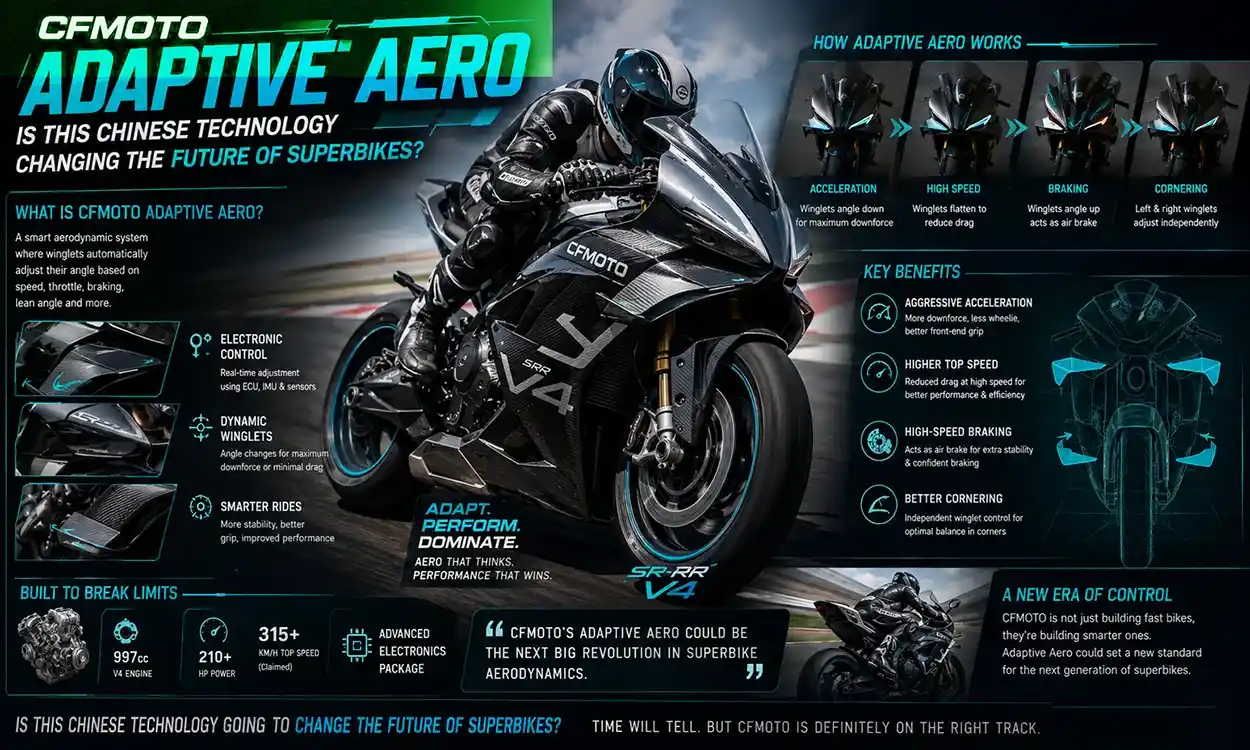
CFMoto V4 SR-RR superbike is an ambitious project by CFMoto, and the V4 SR-RR superbike is being used as a test platform for the CFMoto Adaptive Aero System. It is reported that the prototype bike will feature a 997cc V4 engine, counter-rotating crankshaft, 210+ horsepower, an advanced electronics package, and of course the Adaptive Aero System. CFMoto has already claimed that its V4 platform test engine has achieved a top speed of over 315 km/h, which is a major milestone for the Chinese motorcycle industry.
Is this Chinese technology going to change the future of superbikes?
However, Active Aero has been used successfully in the sports car industry for many years. But the technology is much more difficult to implement in motorcycles due to weight, vibration, reliability, and safety. However, if CFMoto can successfully bring this technology to their production models, manufacturers like Ducati, BMW, Aprilia, and Honda will be forced to follow the same path in the next few years.
And just as winglets were once exclusive features in MotoGP, the Adaptive Aero System could become the new standard for the next generation of superbikes. CFMoto's initiative proves that China is no longer behind Europe and Japan, but is also playing an important role in superbike technological innovation, which is great news for us.
T
Published by Saleh

About Saleh
Writer


Best Bikes

Price: 169800

Price: 255000

Price: 212000


Upcoming Bikes

Price: 85000

Price: 0

Price: 0
